See it work
Watch Caddie research an account.
A short walkthrough: from a single company name to a cited, structured briefing — and the agent loop working underneath.
B2B AI · Agentic RAG
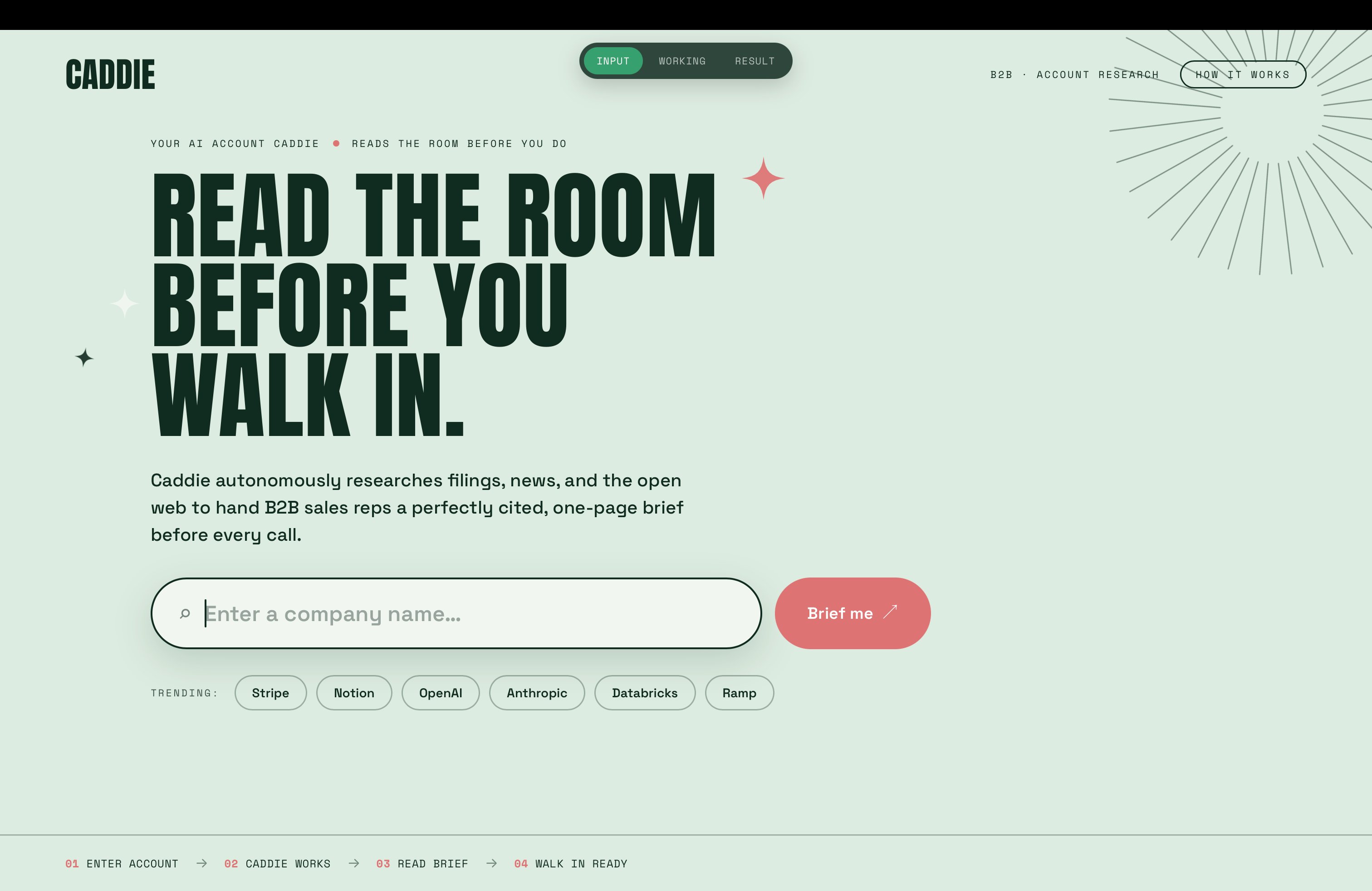
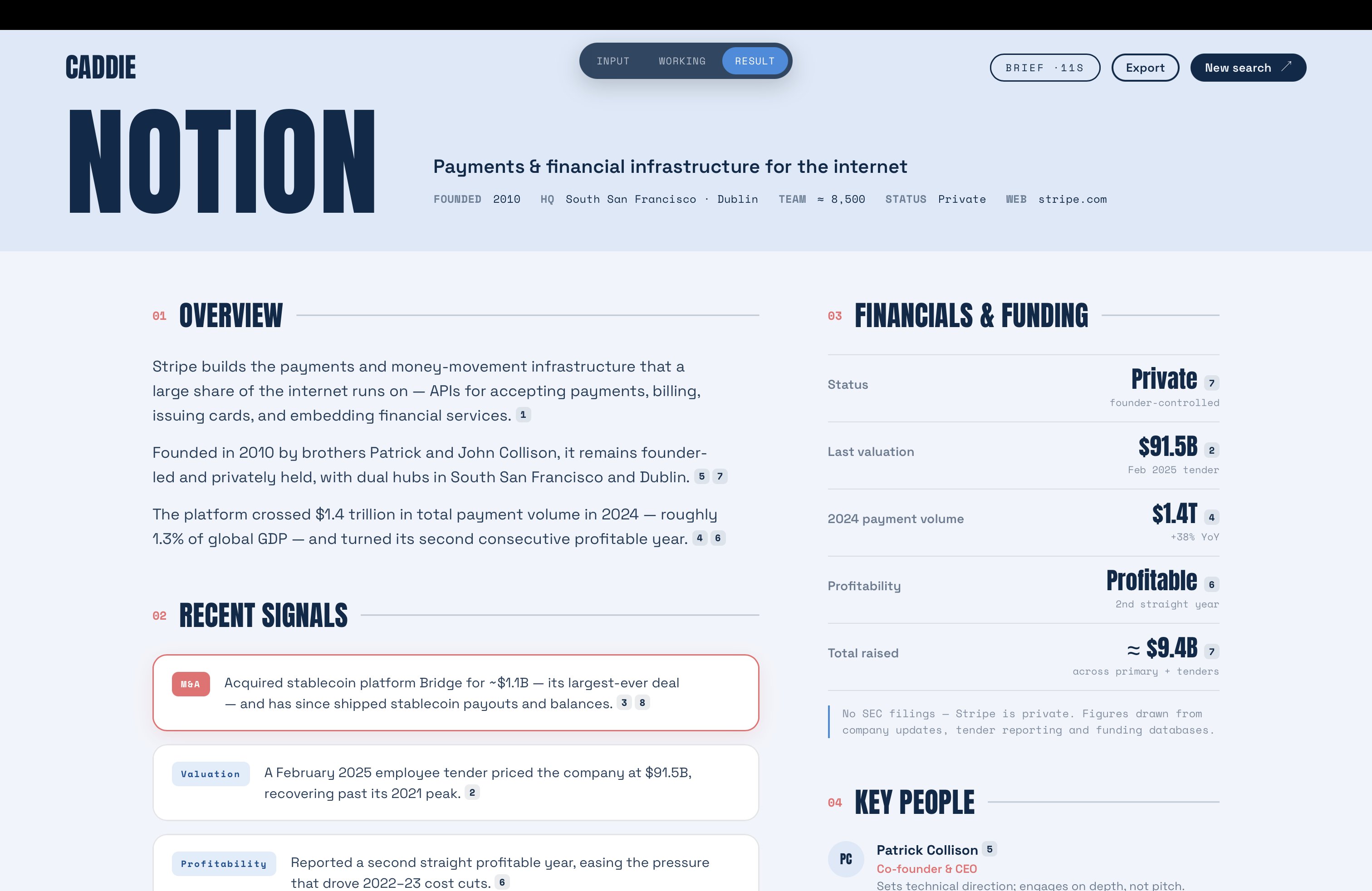
Caddie is a B2B sales-research agent. Give it a company name, and an autonomous agent researches the web, recent news, and filings — then hands back a one-page, fully cited briefing.
Like a caddie who reads the course and hands you the right club, Caddie reads the account and gives the rep exactly what they need before the call.
See it work
A short walkthrough: from a single company name to a cited, structured briefing — and the agent loop working underneath.
01 The problem
Before a call, a rep should know the account cold — what the company does, recent news, financial signals, a hook. In reality that's 30–60 minutes of manual research per account. It doesn't scale, the quality is inconsistent, and most reps skip it.
The obvious counter is "just use ChatGPT." But a general chatbot gives shallow, generic results, a different format every time, and no reliable grounding in the right sources. For a workflow run twenty times a day, you need something specialized, consistent, and cited.
02 The concept
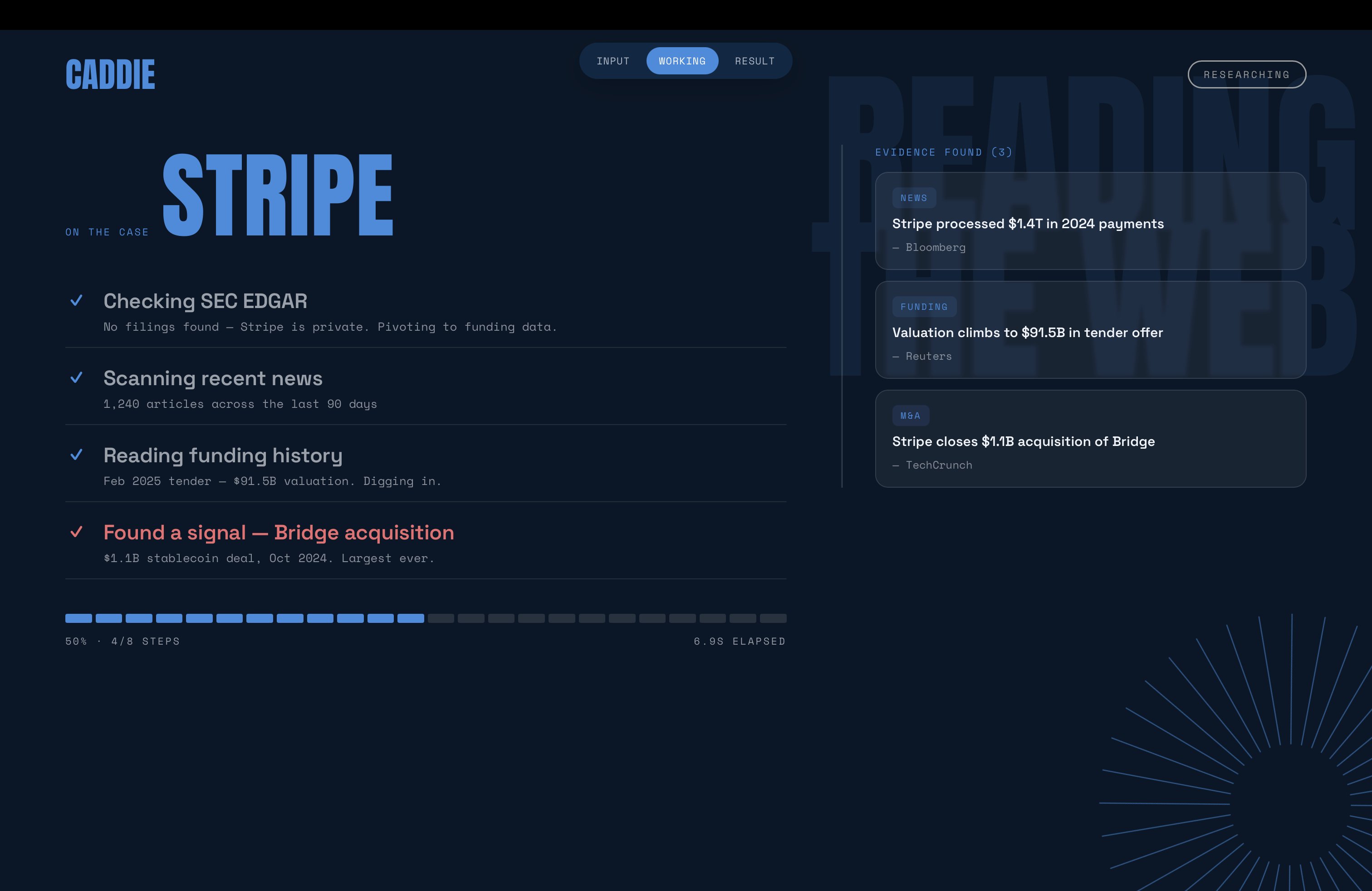
Type in a company name. An autonomous agent researches it across the web, recent news, and company filings, then returns a one-page, fully cited briefing — overview, recent developments, financial signals, and talking points.
No prompting, no babysitting a chat. The rep gets a deliverable, the same shape every time.
03 How it works — agentic RAG
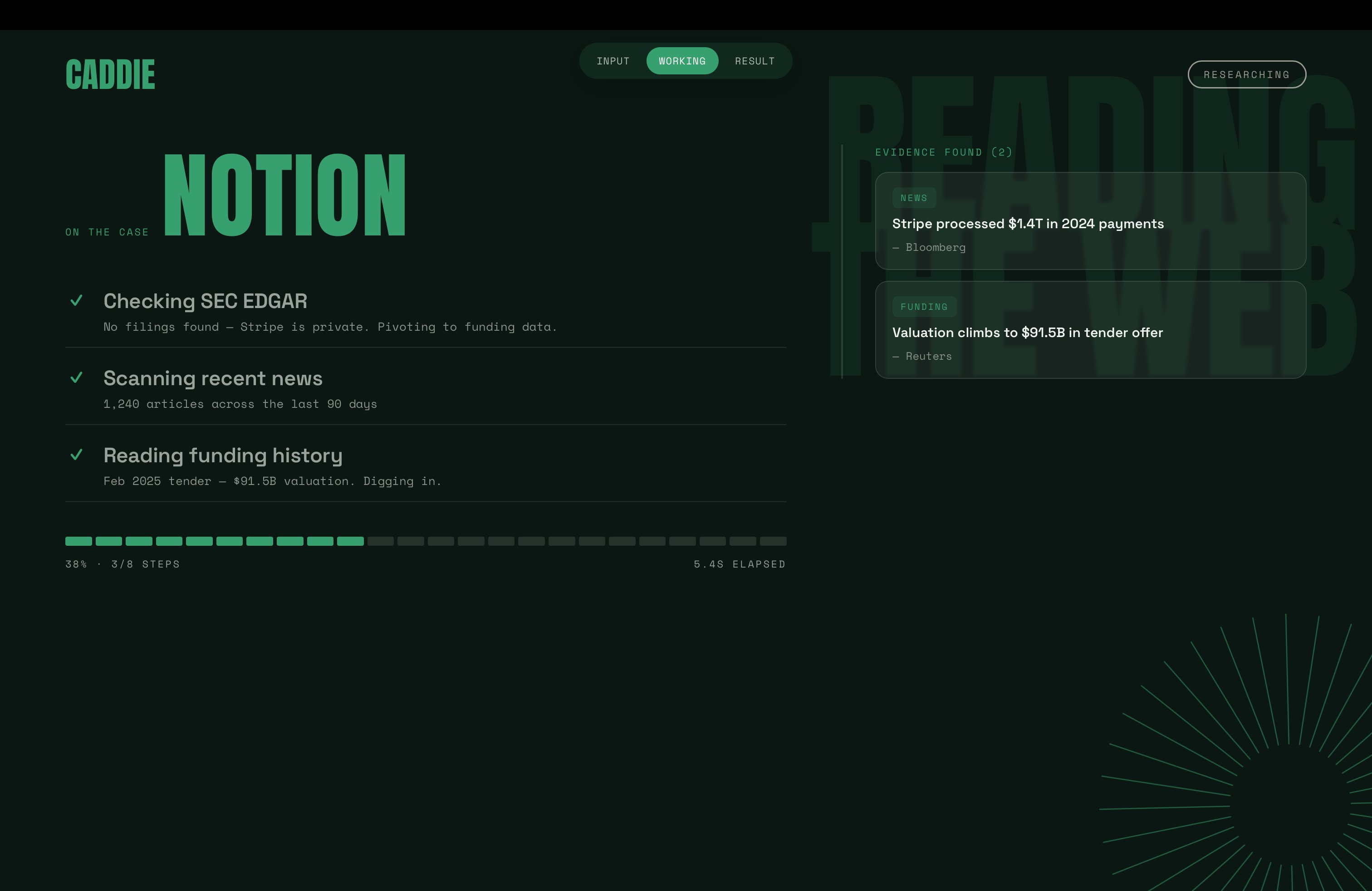
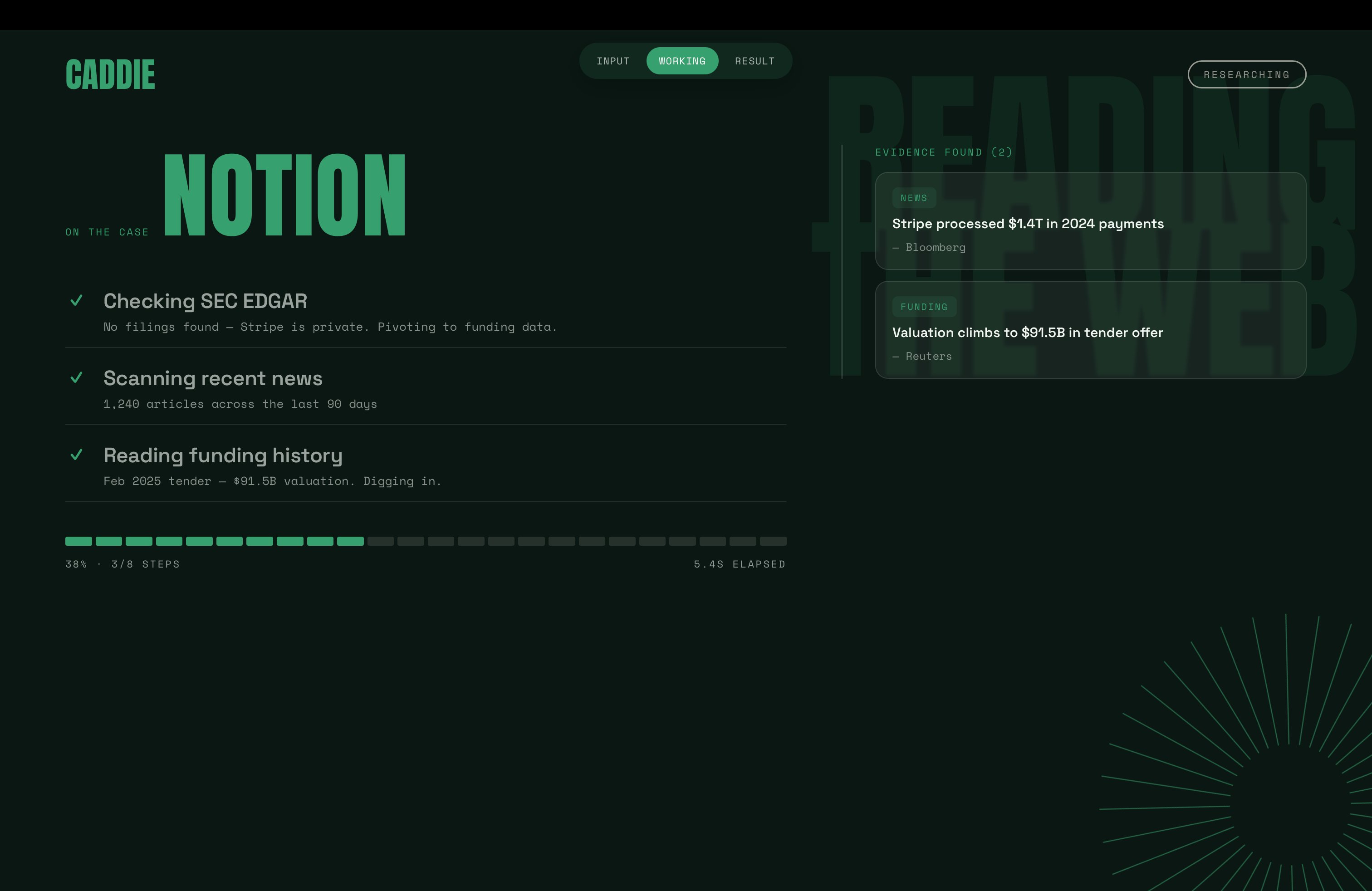
Caddie isn't a one-shot prompt. Its spine is a planner → retriever → synthesizer loop that decides what to fetch, checks if it has enough, and loops before writing.
The planner reasons about what this company needs — overview, news, financials — and sets the research targets.
It calls tools to go get it: web_search, fetch_page, get_filings, corpus_query — exposed through an MCP server.
Retrieved content is embedded into a vector store and reranked, so the most relevant material rises to the top.
The agent asks itself: enough to write a complete brief? If not, it loops back and searches more. This is what makes it agentic, not retrieve-once.
Claude writes the one-page brief from the ranked context — with citations, so every claim is grounded and nothing is invented.
04 Architecture
The research tools sit behind a standard interface the agent calls, instead of bespoke wiring. The same pattern scales to connecting an agent to a client's own systems and data — exactly the kind of B2B AI integration real companies need.
05 Why not just a chatbot
Filings and structured data, not generic web results.
The same briefing format every time, with zero prompting from the user.
Every claim is sourced; reranking and grounded synthesis cut hallucination.
One input, one deliverable — embeddable in a workflow or CRM.
06 Design
The interface is a deliberate aesthetic direction: fresh, characterful, built to feel like a product rather than a demo.
It's also fully token-driven, so re-theming it to a client's brand — colours, type, tone — is the work of an hour, not a rebuild. The same product reskins cleanly for client after client; this look simply gives Caddie its own identity.
07 How it's built
Caddie is built with Claude as an architecture partner and Claude Code as the implementation engine, guided by a CLAUDE.md project bible. Not vibe-coding — I hold the product and architecture decisions and review every step; the AI executes at senior-engineer quality. It's how I take an idea to a working product in days, not weeks.
08 Status & roadmap
The agentic loop, the MCP tool layer, and the retrieval pipeline are the core I'm building out now. Beyond the research brief, the same engine extends into a reusable, multi-tenant B2B platform:
The same agentic RAG, pointed at your own offering — products, case studies and value props as chunks, with exact pricing as structured data — drafts a tailored proposal from the researched prospect context. Hybrid retrieval: semantic where meaning matters, deterministic where numbers must be exact.
Clients upload their own documents through the interface; an ingestion pipeline parses, chunks, embeds and indexes them automatically. No manual onboarding — the product configures itself.
Each client's data is isolated by row-level security — private, never mixed, GDPR-aligned. With brand-level theming on top, a new client means: re-skin, upload, done. Build the engine once; everyone onboards themselves.